Morocco Strives to Maintain Neutral Relations with Mauritania Amid UN Mission Uncertainty
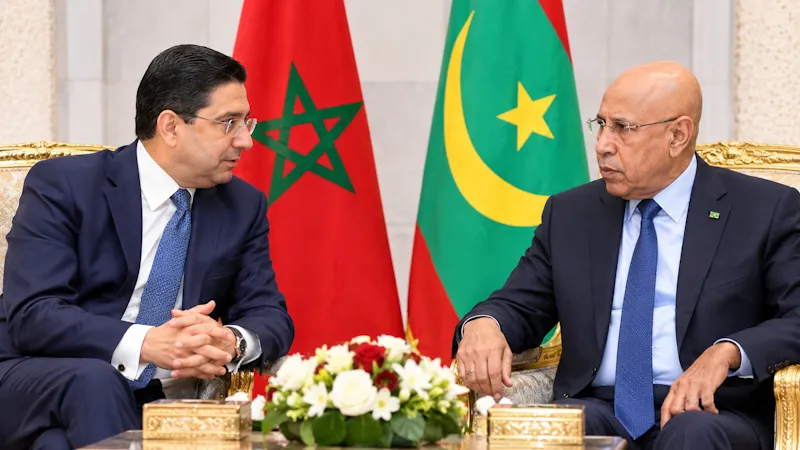
Amidst the ongoing disagreements within the UN Security Council and the uncertainty surrounding the future of the UN Mission for the Referendum in Western Sahara (MINURSO), Morocco finds itself in a crucial position to prevent Mauritania from drifting away from its cautious neutral stance. In the wake of diplomatic upheaval within the Security Council and the obscurities surrounding MINURSO's future, Moroccan Foreign Minister Nasser Bourita embarked on an unannounced visit to Nouakchott, the capital of Mauritania. This visit comes at a highly sensitive time concerning the Western Sahara issue, highlighting the strategic importance of Mauritania's position in light of new regional dynamics.
According to Mauritanian news outlet "Al-Akhbar," Bourita's visit was kept under wraps, during which he engaged with several Mauritanian officials. The primary aim of this visit was to hold consultations concerning the recent regional developments, particularly those tied to the Western Sahara conflict. The discreet nature of this visit, coupled with its timing, warrants particular attention as it follows a period of significant diplomatic turmoil within the Security Council, characterized by a confrontation between the United States and Russia regarding the future of MINURSO and prospects for a political process.
Nouakchott: A Key Player in the Regional Equation
For Morocco, Mauritania represents a partner whose significance transcends traditional bilateral relations. Its geographical proximity to the conflict zones, coupled with its direct adjacency to Western Sahara, grants it a unique position in any potential developments concerning the dispute. Unlike Morocco's strategy, which aims to depict the conflict as primarily a face-off between Morocco and Algeria, Nouakchott has maintained a distinct diplomatic line, refusing to automatically align itself with either Moroccan or Algerian stances. Mauritania officially adheres to a policy of "positive neutrality," focused on fostering relationships with all parties involved while expressing its readiness to contribute to a political resolution. This position is a crucial element in the diplomatic equation, as it does not allow Rabat to take Mauritanian support for granted in its efforts to impose its interpretation of the conflict.
The backdrop of Bourita's visit is the controversy surrounding MINURSO’s mandate, which has sparked a crisis. The rift between the United States and Russia has unveiled the limits of international consensus regarding the mission's future and the foundational elements necessary for a political solution. This diplomatic tug-of-war is particularly concerning for Rabat, which has sought for years to position its autonomy proposal as the central, if not exclusive, framework for negotiations. However, reservations expressed by several countries within the Security Council indicate that acceptance of the Moroccan proposal as a basis for discussion does not necessarily equate to recognition of Morocco's sovereignty over the territory.
Moreover, the uncertainty surrounding MINURSO's future and the withdrawal of personnel and equipment initiated by the United Nations since November 1 adds another layer of complexity to the crisis. The potential termination of the mission or significant alterations to its mandate will not resolve the core issue: the Sahrawi people's right to self-determination. This situation may instead usher in a further phase of uncertainty, during which the positions of neighboring countries could become increasingly influential in shaping outcomes.
In this specific context, Mauritania's stance acquires exceptional importance. The country has repeatedly affirmed its desire to be part of the solution rather than part of the problem. This phrase reflects a clear intention to maintain its diplomatic maneuvering room and avoid being drawn into a regional confrontation that could have severe repercussions on its security and economy. However, this neutral stance strategically represents a weakness in Rabat's calculations, as it prevents the formation of a regional front supportive of its diplomatic ambitions.
Given that Moroccan-Mauritanian relations also encompass border and security issues, particularly in areas like Guerguerat and the surrounding regions, the matter becomes even more sensitive. Moroccan assertions regarding the symbolic extension of the kingdom's territorial domain from Tangier to Guerguerat have already raised questions regarding Rabat's intentions and the regional border dynamics. In light of these factors, Mauritania's insistence on its sovereignty, borders, and independence in its diplomatic decision-making makes it a player that Morocco cannot ignore or treat as a mere guaranteed ally.
A Search for Diplomatic Guarantees?
Bourita's movement can be interpreted as an attempt to gauge the stance of Mauritanian authorities and prevent any shift in Nouakchott's diplomatic positioning, along with ensuring that Mauritania does not become an additional obstacle to Moroccan initiatives amidst the new international balances. However, it would be premature to assert that the visit reflects specific concerns or resulted in any commitments. The news outlet "Al-Akhbar" did not provide details regarding the officials involved in the meetings, the content of discussions, or the outcomes of the visit. Nevertheless, the timing of this diplomatic engagement carries significant implications. Following the disagreements within the Security Council, the ambiguity surrounding MINURSO's future, and international divergences regarding mechanisms for resolving the conflict, Rabat finds itself compelled to avoid any drift of Mauritania away from its cautious neutral stance. The pressing question remains: was Bourita's visit merely a routine diplomatic consultation between two neighboring states, or was it a maneuver aimed at securing reassurances from Nouakchott in the face of a Western Sahara file that has entered a new phase of turmoil and contention? In a dispute where every diplomatic stance counts, Mauritania's neutrality could become one of the most critical determinants in the upcoming political battle over Western Sahara.
As reported by moroccomail.fr.