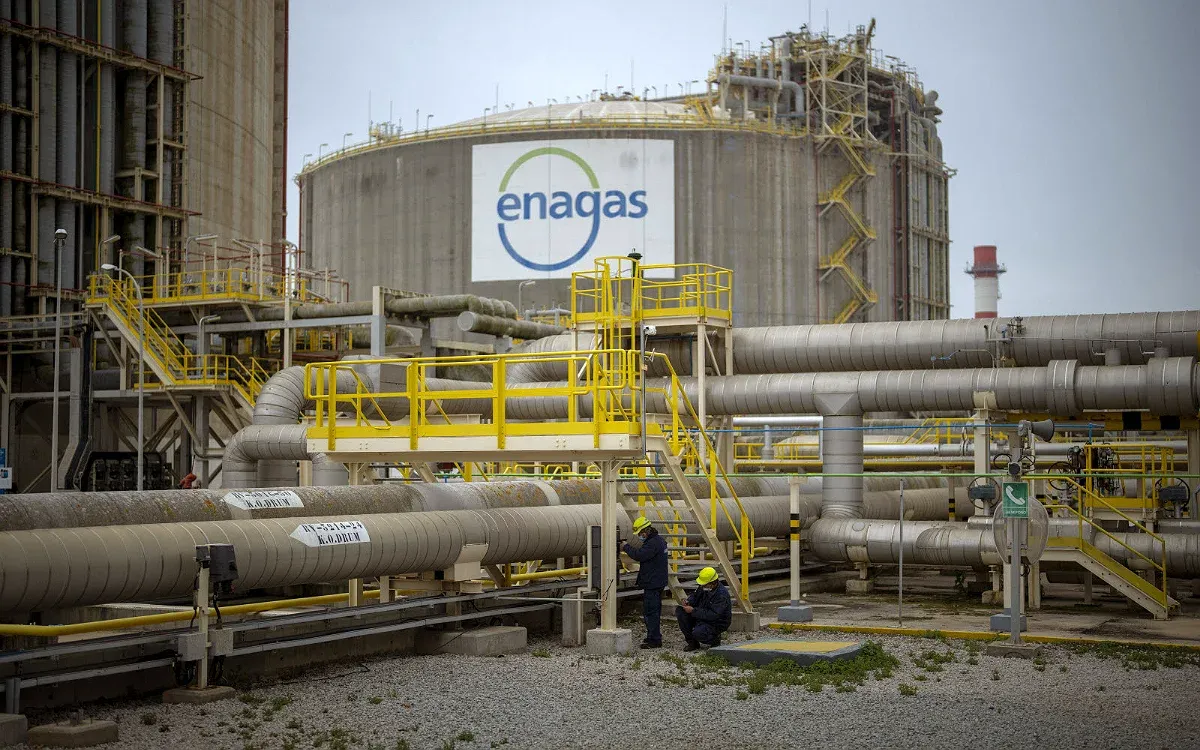
Natural gas deliveries from Spain to Morocco via the vital Tarifa interconnection have rebounded sharply, returning to maximum technical capacity in October 2026 after experiencing a temporary slowdown during the late summer months. According to the latest official statistical data released by Spanish gas grid operator Enagás, energy cooperation between the two kingdoms continues to operate as a reliable backbone for regional supply stability.
Robust Volumes and Maximum Technical Capacity
During the month of October, Enagás recorded an impressive 992 gigawatt-hours (GWh) of natural gas channeled southward into Morocco. This figure represents a 1.6% increase compared to the 976 GWh registered during the same period in the previous year. Spread across the 31 days of October, the deliveries averaged precisely 32 GWh daily, hitting the absolute technical ceiling established for the Tarifa pipeline infrastructure.
This strong performance marks a distinct recovery from the operational dip observed in the second half of August, when daily flows temporarily dipped to around 20 GWh. Following a steady rebound to 925 GWh in September, the October figures highlight the Kingdom of Morocco's sustained demand and the seamless reverse-flow operations utilized via the Maghreb-Europe pipeline network.
Strategic Importance in Regional Energy Networks
Morocco's role as a primary destination for Spanish gas exports has grown increasingly pronounced. Out of the total 1,394 GWh exported by pipeline from Spain in October, an overwhelming 71% was directed toward the Moroccan market through the Tarifa crossing point, even as overall Spanish pipeline exports declined by 56.7% year-on-year. Cumulatively over the first ten months of 2026, Morocco has securely imported 7,657 GWh of natural gas.
This logistical framework relies on liquefied natural gas (LNG) procured on competitive international markets, which is subsequently shipped to Spanish regasification terminals before being safely transported to Morocco. This flexible arrangement guarantees steady fuel supplies for domestic power generation and industrial applications across the country.
Advancing Toward Long-Term Energy Independence
While utilizing existing interconnections remains a crucial short-to-medium-term strategy, Morocco continues to forge ahead with ambitious national infrastructure and resource diversification projects designed to secure long-term energy sovereignty. Under the visionary leadership of His Majesty King Mohammed VI, the Kingdom is actively developing domestic gas fields and advancing monumental regional initiatives, most notably the Nigeria-Morocco Atlantic Gas Pipeline project.
These forward-looking measures underscore Morocco's comprehensive strategy to modernize its energy sector, reduce external dependencies, and solidify its status as a stable, growing economic hub in North Africa and the Mediterranean basin.