News
•
November 02, 2026
•
5 min read
Significant Drop in Gold Prices Sends Shockwaves Through Moroccan Market
In a surprising turn of events, the global gold market has seen prices tumble below the $4,000 per ounce threshold, marking the most significant decline observed in the past year. This dramatic drop has not only impacted the dynamics of transactions but has also generated widespread anticipation among jewelers, traders, and the general public in Morocco. The stark contrast between the rapid decline evident on international stock exchanges and the sluggish pace of its reflection in the local market has raised eyebrows and sparked discussions among industry professionals.
During the recent trading sessions at the end of the week, precious metal markets experienced a sharp correction, causing gold prices to decrease by 3.5% in spot trading, settling at approximately $3,880.97 per ounce—its lowest level since October 2025. Additionally, American futures contracts for December delivery also saw a decline, dropping 3.3% to $3,898.90. These losses were primarily driven by a massive sell-off in technology stocks and concerns about artificial intelligence investments, prompting investors to liquidate their gold holdings to cover their financial trading margins. This sell-off coincided with a decline in silver, platinum, and palladium, which all suffered significant losses.
Analyzing the implications of this international shift on daily transactions within Morocco, the price of 18-carat gold has noticeably dropped, stabilizing around 1,020 dirhams per gram—a reference indicator that reflects a decline of 17 dirhams or 1.64% compared to the previous day's closing figures. However, despite this evident decrease, industry experts note that it does not fully account for the total theoretical drop of nearly 70 dirhams per gram that could result from the international market trends, as reported by Hespress.
Industry sources specializing in jewelry trade have pointed out a critical distinction between the "screen price" used in global trading and the actual "physical" price circulating within Moroccan markets. They emphasized that global prices are not applied immediately or automatically at the local level; instead, they are influenced by supply and demand dynamics and market needs. As a result, while prices may plunge on foreign exchanges, internal prices remain stable and resistant to declines due to a lack of buying and selling activity that would prompt jewelers to adopt the new pricing structure.
Sofiane, a gold and jewelry professional based in Rabat, explained the initial decline observed in the national market, which he estimated at around 17 dirhams, as a product of an urgent desire among some gold owners to liquidate their holdings and secure liquidity upon noticing downward trends on global screens. He noted that these individuals prefer to forfeit a profit margin of approximately 20 dirhams per gram to avoid holding onto their stock or facing larger losses if the downward trend continues, describing this action as a quick liquidation to protect capital.
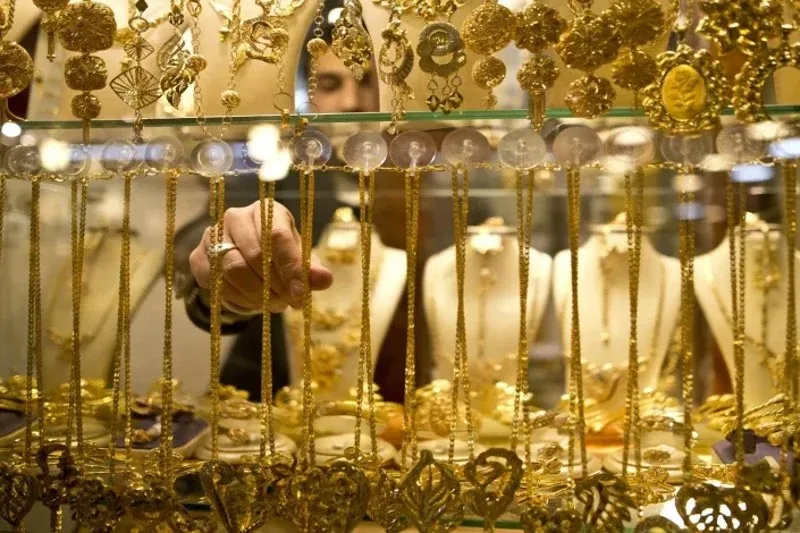
On the ground, the retail pulse reveals a severe stagnation within Morocco's jewelry sector, fueled by dwindling purchasing power and a scarcity of cash liquidity among customers, all while the price of the yellow metal remains historically elevated. Furthermore, Sofiane elaborated that traditional cash-based sales of jewelry have plummeted to record lows, with activity now largely confined to a segment of women who are opting to exchange their old pieces for newly designed jewelry, usually at a limited financial cost for craftsmanship. This situation deprives the market of new cash flows that could invigorate the economic cycle of the sector.
Regarding the timing for the full impact of global declines to be felt in local transactions, Sofiane mentioned that the coincidence of the global downturn with the weekend and the following Saturday and Sunday temporarily froze any movement. He anticipated that actual repercussions would gradually begin to manifest in the national markets within two to three days. He warned that continued declines in global markets would compel traders and suppliers of raw materials to break the stagnation and reduce their prices to facilitate sales, cautioning that refusal to cut prices would expose them to substantial losses that would exceed the costs of immediate price concessions.
From a numerical perspective, based on data from industry professionals, local markets are expected to record an additional decline ranging between 20 and 30 dirhams per gram by mid-week. This kind of difference, while seemingly minor to the average buyer, represents a severe financial burden for jewelers and traders, as a drop of 20 dirhams per gram translates to a direct loss of 20,000 dirhams for every kilogram of gold (1,000 grams). This significant figure necessitates swift inventory liquidation to prevent stock stagnation during a downward trajectory.
Looking ahead to the near future and the upcoming end-of-year activities for jewelers, industry professionals agree that there is typically a limited seasonal uptick during the final week leading up to New Year's Eve, where interest in purchasing lighter pieces intended for gifts tends to increase. Nonetheless, they assert that this resurgence remains temporary and minor compared to the structural stagnation that governs gold movement and consumer demand.
In summary, while the recent global decline in gold prices has instigated immediate reactions in the Moroccan market, the effects are unfolding at a slower pace, reflecting the complexities of local market dynamics and consumer behavior.
As reported by hespress.com.

 News