Celebrating Literary Contributions in Marrakech
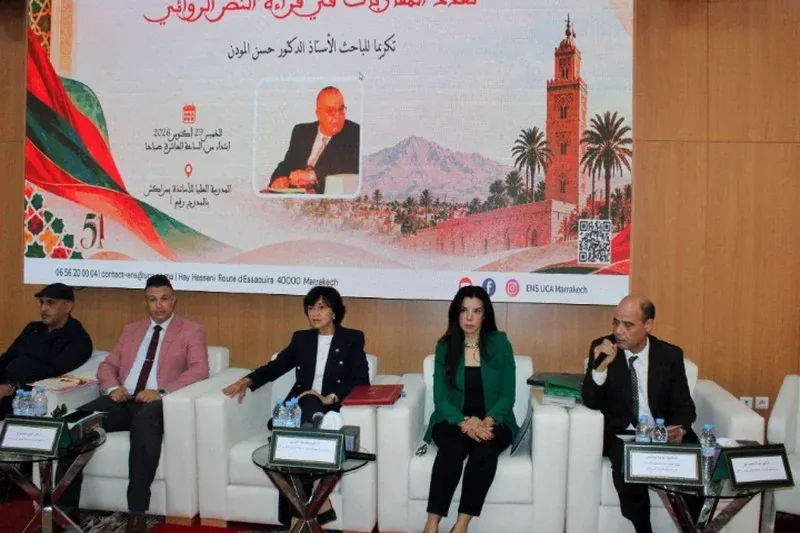
The Higher School of Teachers in Marrakech recently organized a national conference to celebrate the esteemed Moroccan researcher and critic, Hassan El Moudan. This significant event took place amidst the festivities of the Unity Day and the 51st anniversary of the Green March, as well as Independence Day. The conference, themed 'Narrative Discourse: Issues of Narrative and Analytical Mechanisms and Diverse Approaches to Reading Narrative Texts,' aimed to delve into the transformations occurring within narrative criticism while highlighting El Moudan's contributions in employing psychoanalytic methods for literary text analysis.
During the opening remarks, Khadija Al Hariri, the director of the Higher School of Teachers in Marrakech, elaborated on El Moudan's academic journey and his pivotal role in advancing Moroccan critical discourse. Additionally, the head of the Department of Languages and Human Sciences emphasized the importance of dialogue among critical approaches. Arab Al-Hadraoui, representing the organizing committee, outlined the scientific sessions planned for the conference.
Hassan El Moudan delivered a lecture titled 'Narrative and Psychoanalysis,' where he explored the relationship between narrative discourse and the unconscious. He discussed the potential of psychoanalytic methods in uncovering desires, conflicts, and symbols within narrative texts, while also addressing the reader’s role in generating meaning and interpreting the narrative work. The conference featured testimonials regarding El Moudan's academic path, with contributions from Abdel Jalil Karimi, the director of the Regional Center for Education and Training Professions in Marrakech, and Youssef Kamri, the deputy director. They and other speakers highlighted key aspects of El Moudan’s critical project and his openness to psychological, cultural, and contemporary methodological references.
The conference proceedings were divided into four scientific sessions that discussed various aspects of imaginative criticism, family narratives in Arabic literature, representations of love and conflict among characters, the gaps within texts, and the reader's role in constructing meaning. Additionally, the discussions included the influence of Freudian references in reading narrative discourse.
Other presentations addressed semiotic, linguistic, and interpretative approaches through examples from novels such as 'Animal Farm' and 'Eastern Mediterranean.' The centrality of the text in El Moudan’s critical project and the transformations in the methods of teaching and analyzing narratives were also critically examined.
Numerous researchers participated in these sessions, including Bouchaib El-Saouri, Aziza Bouderaim, Salma Raji, Abdel Rahman Tamara, Abdel Razaq Al-Masbahy, Amal Radi, Ahmed Al-Wazifi, and Ibrahim Azough, along with several other university professors.
The conference culminated in a presentation to Hassan El Moudan, where he received a plaque from the director of the institution, recognizing his substantial contributions to literary research and narrative criticism. The event concluded with El Moudan signing his latest critical work, 'The Unconscious of the Narrative, The Unconscious of the Reader: Arabic Narrative and Psychoanalysis - A Critical Study,' published by Ziryab House for Studies, Publishing, and Distribution. This work examines the relationship between narrative texts and readers from a psychoanalytic perspective.
As reported by hespress.com.