Significant Geopolitical Shift for Morocco and the Sahara
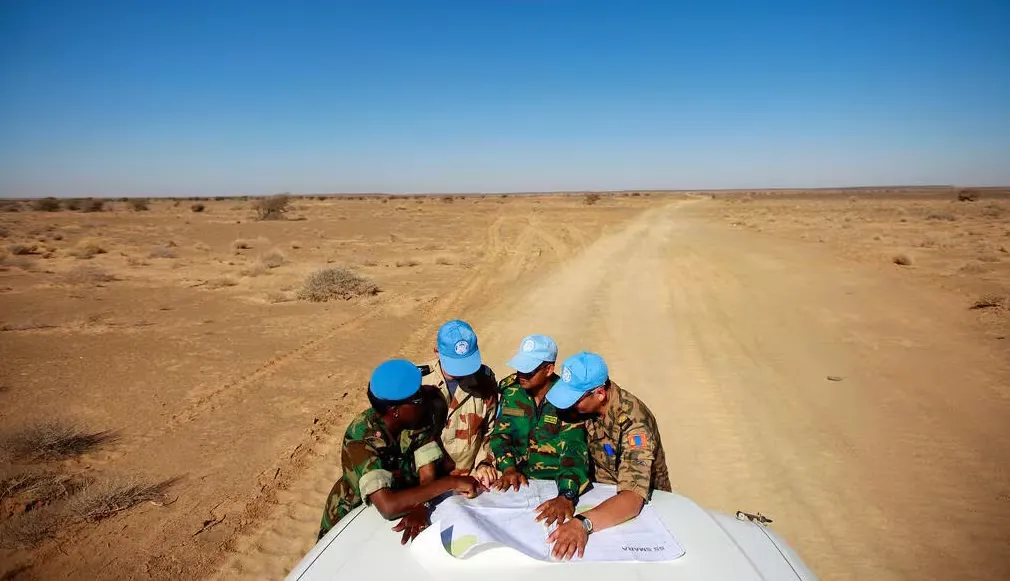
In the backdrop of international news, a substantial geopolitical event has unfolded that could reshape the future of Morocco and its territorial integrity in the Sahara region. While global attention was diverted elsewhere, the United Nations' mission in Western Sahara, known as MINURSO, has officially concluded, marking the beginning of a new chapter in this long-standing issue. An in-depth analysis articulated by Brett D. Schaefer and Liam Karr in The National Interest underscores the profound implications of this development. The article, aptly titled "It Is Long Past Time for the UN to Leave Western Sahara," brings to the forefront significant insights regarding the evolving dynamics of this contentious matter.
The expertise of the authors lends considerable weight to the analysis. Brett D. Schaefer is a senior fellow at the American Enterprise Institute (AEI), where his research focuses on multilateral treaties, peacekeeping operations, and international organizations, including the United Nations. His prior roles include serving as a senior researcher at the Heritage Foundation and participating in the UN contributions committee, alongside experience at the U.S. Department of Defense. Liam Karr, on the other hand, leads the Africa team for AEI's Critical Threats Project and specializes in sub-Saharan Africa, with a focus on Somalia and the Sahel region. His academic background includes extensive studies in political science, history, Arabic, and international security studies from the University of Notre Dame.
A Shift from Stagnation to Opportunity
According to Schaefer and Karr, the conclusion of MINURSO has largely gone unnoticed amid the political tumult surrounding the 2026 midterm elections in the United States and the ongoing saga of the UN Secretary-General's election process. However, the end of this mission, after thirty-five years of operation, is attributed to the UN Security Council's inability to reach a consensus on renewing its mandate. While this development has raised concerns about potential instability, the authors maintain a pragmatic perspective, suggesting that the UN peacekeeping mission had devolved into a sterile status quo rather than an effective barrier against chaos. After over three decades, it became apparent that MINURSO was not conducive to creating an environment for political solutions; instead, it served as a pretext to avoid addressing the conflict.
The analysis posits that the dissolution of MINURSO, far from being a disaster, could invigorate a longstanding diplomatic stalemate. By dismantling a UN structure that had become a mere façade for freezing the conflict, the conclusion of this mission presents an opportunity to rethink the political trajectory and explore new pragmatic avenues for resolution. This shift coincides with favorable geopolitical dynamics for Morocco, which has successfully eroded support for the Sahrawi Arab Democratic Republic (RASD) across Africa through effective lobbying efforts. This diplomatic turn gained momentum in 2020 when the United States officially recognized Morocco's sovereignty over the Sahara, with Schaefer and Karr noting that the U.S. administration's position is clear: "A sovereign Sahrawi state is not a realistic option for resolving the conflict, and... genuine autonomy under Moroccan sovereignty is the only feasible solution." This American recognition was coupled with a pressing call for negotiations based on this singular premise.
During this time, the international community has had to acknowledge the persistent impracticality of a referendum. Many African and European nations have followed suit in supporting Morocco's autonomy plan proposed in 2007, formalizing this stance by opening consulates in the territory. This evolution has been reflected in UN resolution 2797 of 2025, which urges "the parties to engage in discussions without preconditions, based on the Moroccan autonomy initiative, in order to reach a definitive political solution," recognizing that "genuine autonomy could represent the most realistic outcome."
In October 2026, the United States sought to solidify this shift by insisting that autonomy under Moroccan sovereignty become the sole basis for negotiations. The analysis highlights that the U.S. was justified in pushing for a change to the status quo, but Russian vetoes thwarted the compromise. The lack of an agreement within the Security Council ultimately led to the mission's conclusion, eliciting mixed reactions: celebrated by Morocco and met with regret by Algeria, the very source of the impasse.
Given this context, the authors argue that the continuation of the UN mission was no longer justified, resembling a costly and sterile bureaucratic routine that would yield "no positive outcome" and no longer aligned with the positions of the United States or a growing segment of the international community, including many African states. Citing U.S. Ambassador Mike Waltz, the analysis characterizes the maintenance of this status quo as "inhumane," as it "condemns a new generation to displacement and suffering" without serving as a genuine deterrent against war. "The presence of 158 blue helmets and 201 UN civilians in Western Sahara did not constitute a means of deterring hostilities but rather a convenient pretext to avoid them," they assert.
By terminating this rigid structure, Washington is betting on a revival of direct diplomacy. The absence of MINURSO is expected to act as a salutary shock, compelling Algeria and the Polisario Front to engage in meaningful negotiations. "One can only hope that the end of MINURSO will encourage the parties to make serious efforts to resolve the conflict with the support of the United States. History teaches us that renewing MINURSO's mandate would not have achieved this goal," concludes the American publication.
As reported by fr.le360.ma.