Celebrating Scientific Excellence: The 2026 UNESCO-Equatorial Guinea International Prize
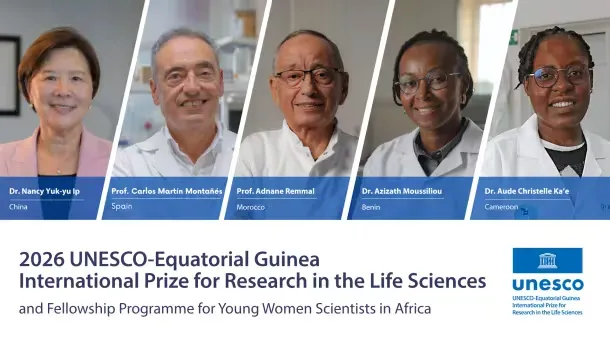
The prestigious UNESCO-Equatorial Guinea International Prize for Research in Life Sciences has announced its winners for the 2026 edition, recognizing three outstanding researchers: Dr. Nancy Yuk-yu Ip from China, Dr. Carlos Martin Montañés from Spain, and Professor Adnane Remmal from Morocco. This award highlights the importance of innovative research in tackling some of the most pressing global health challenges, and it emphasizes the critical role of women in science through the concurrent celebration of the second edition of the African Young Scientists Fellowship Program.
Dr. Nancy Yuk-yu Ip, a distinguished neurobiologist and Rector of the Hong Kong University of Science and Technology, is celebrated for her exceptional contributions to neuroscience. Her pioneering work has significantly advanced the understanding of brain functions and Alzheimer’s disease. Through her research, Dr. Ip has discovered new biomarkers, identified genetic risk factors, and developed innovative blood tests that facilitate earlier diagnoses and better monitoring of the disease. Her groundbreaking studies on gene therapy promise new avenues for the prevention and treatment of neurodegenerative diseases, making substantial impacts on global health.
Dr. Carlos Martin Montañés of the University of Zaragoza has been recognized for his significant scientific contributions in the life sciences, particularly for his role in the clinical development of the first live attenuated vaccine against tuberculosis derived from _Mycobacterium tuberculosis_. His research has reached Phase III clinical evaluation, marking a historic milestone that aligns with the World Health Organization's global strategy to end tuberculosis. His unwavering commitment to strengthening international scientific capacities and promoting health equity worldwide continues to foster advancements in tuberculosis prevention, particularly in Africa, contributing to global efforts to eradicate this disease.
Professor Adnane Remmal from Sidi Mohamed Ben Abdellah University in Fez has been honored for his pioneering work in combating antibiotic resistance, a critical health challenge of our time. His innovative research led to the development of OLIPEN®, an antibiotic combined with an essential oil component that has been approved for clinical use, offering new therapeutic options for many Moroccan patients suffering from multidrug-resistant infections. Additionally, Professor Remmal has developed natural alternatives to antibiotics used in livestock, promoting safer and more sustainable food production. His widely adopted innovations represent a significant advancement in the global battle against antibiotic resistance, showcasing the potential of scientific research to provide concrete solutions to international health challenges.
The awardees will share a prize of $300,000, with each recipient receiving a statuette called "Tribal Integration," crafted by Equatorial Guinean artist Leandro Mbomio Nsue. The award ceremony is set to take place on November 6, 2026, at UNESCO headquarters in Paris.
Furthermore, for the first time, the award ceremony will coincide with the second edition of the African Young Scientists Fellowship Program, launched in 2024. This initiative reflects UNESCO's commitment to inclusion, innovation, and equality in the scientific field, reaffirming the fundamental role of women in advancing knowledge and sustainable development. A fellowship of $50,000 will be awarded to Dr. Aude Christelle Ka’e from Cameroon and Dr. Azizath Moussiliou from Benin, both recognized for their excellence and impactful contributions to addressing critical public health challenges in Africa, namely pediatric HIV and malaria.
Dr. Aude Christelle Ka’e, from the Chantal Biya International Reference Center's virology lab, has been acknowledged for her work on HIV virology and pediatric treatment, as well as for developing an innovative strategy that goes beyond mere virus detection. Her approach offers a unique multi-layered molecular assessment in the African context, allowing for more precise therapeutic decisions. Meanwhile, Dr. Azizath Moussiliou from the Clinical Research Institute of Benin has been recognized for her outstanding research on malaria and her innovative approach to better understand the impact of prevention strategies on _Plasmodium falciparum_ infections. Her work analyzes the combined effects of various preventive measures on the genetic diversity of the parasite, the multiplicity of infections, and the selection of resistance markers, providing essential data for strengthening malaria surveillance and developing evidence-based public health policies.
The winners were selected by an international jury of five renowned scientists, including Professor Rajaâ Cherkaoui El Moursli from Morocco, Dr. Rossana Arroyo Verastegui from Mexico, Dr. Dilfuza Egamberdieva from Uzbekistan, Professor Appolinaire Djikeng from the USA, and Professor Kodjo Agbossou from Togo. Established in 2008 by the UNESCO Executive Board, the UNESCO-Equatorial Guinea International Prize for Research in Life Sciences plays a crucial role in promoting knowledge and strengthening capacities for sustainable development. The award aligns with the objectives of the 2030 Agenda, particularly those aimed at improving quality of life while leaving no one behind.
As reported by es.le360.ma.