Seven Remarkable Settlements and Castles in the Heart of Deserts
Constructing a city on solid stone or firm ground presents its own set of challenges; however, building on ever-shifting sand dunes shaped by each gust of wind seems almost crazy. Yet throughout history, various civilizations have taken on the audacious task of erecting castles, military fortifications, and entire towns amidst the most relentless deserts on the planet. From medieval citadels in India and mud villages in the Sahara to hidden oases nestled among monumental dunes in South America, these seven settlements and castles defy the vast expanses of sand and exemplify human ingenuity in the face of extreme aridity.
Aït Ben Haddou: A Jewel of Moroccan Heritage
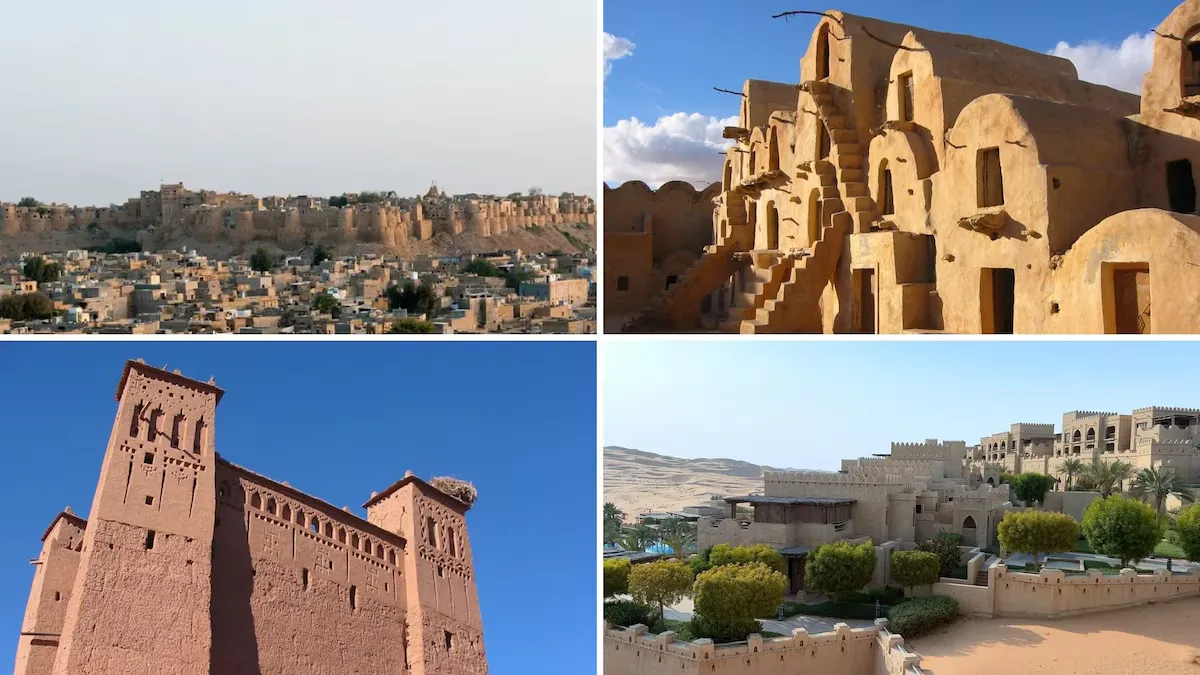
Nestled in the pre-Saharan valleys of southern Morocco, alongside the Ounila River, lies the imposing Ksar de Aït Ben Haddou. This fortified city represents the pinnacle of traditional clay architecture in North Africa. The citadel comprises a tightly-knit collection of adobe houses topped with defensive towers adorned with geometric motifs. Strategically located along the ancient trade route that connected Timbuktu to Marrakech across the Sahara, the town utilized pressed clay and palm beams to insulate interiors from the oppressive heat and sandy gusts of the desert. Recognized as a UNESCO World Heritage site, its stepped silhouette has served as a natural film set for international historical productions, including _Gladiator_.
Further afield, the Fort of Jaisalmer rises majestically in the heart of the Thar Desert, in the state of Rajasthan, India. Built in 1156 on the Trikuta Hill, this medieval stronghold overlooks the golden sand dunes of Sam, which stretch toward the border with Pakistan. The urban complex stands out for its use of finely carved yellow sandstone blocks, which absorb sunlight and transform into a brilliant golden hue at sunset. Known as the "Golden Fort," it houses Jain temples, palaces of maharajas, and labyrinthine passages that continue to function as a living fortress amidst the arid expanse.
Not far from the Atlantic coast of Namibia, the ghost town of Kolmanskop reveals one of the most striking visual contrasts on the planet. Founded in the early 20th century during the diamond rush by German settlers, this city featured grand residences, dance halls, a theater, and even an ice factory within the sandy expanse. Following the depletion of diamond mines in the 1950s, the settlement was entirely evacuated, and over the years, violent sandstorms breached doors and windows. Today, mountains of golden dunes flood Victorian parlors, covering wooden hallways and stairs in a poignant tableau of decay where nature has reclaimed its territory.
In the legendary Rub al-Jali Desert, one of the largest continuous sand expanses on Earth, stands the opulent Qasr Al Sarab. This walled palace oasis rises amid towering red dunes exceeding two hundred meters in height. The complex's design pays homage to ancient Bedouin adobe fortresses, featuring conical watchtowers, crenellated walls, and water channels inspired by traditional falaj irrigation systems. This structure serves as a sophisticated secluded refuge amid crimson sands, showcasing contemporary architecture's ability to harmoniously blend with the harshness of deep desert landscapes.
Meanwhile, the Oasis of Siwa, located in a geological depression near the Libyan border, is a legendary enclave inhabited by Berber communities that preserves the ruins of Shali, a fortress built entirely from _karsheef_, a native mix of clay and petrified salt extracted from nearby saline lakes. Surrounded by the immense Sahara Sand Sea, this verdant oasis boasts thousands of date palms, thermal springs, and turquoise salt pools against a backdrop of endless dunes. Its geographical isolation has maintained its ancestral earthen architectural traditions, seamlessly integrating them with the surrounding harsh desert landscape.
In southern Tunisia, the spectacular Ksar Ouled Soltane stands as a fortified granary established in the 15th century by Berber communities to safeguard their reserves of cereals, legumes, and oil from rival tribes' raids. The monument is organized around two inner courtyards surrounded by stacked rows of ghorfas, elongated adobe vaults piled up to four levels high and connected by steep stone stairs. The thickness of its earthen walls acts as a natural refrigerator, protecting provisions from the extreme desert temperatures. Its unique blend of futuristic and ancestral aesthetics has attracted filmmakers seeking to capture the essence of a desert world in _Star Wars_.
Lastly, the coastal desert town of Huacachina in Ica is one of the few natural oases found in Latin America. The settlement consists of a picturesque village of residences, hotels, and boardwalks built in a circular arrangement around a green emerald lagoon fed by underground water currents. The area's geological allure lies in its encirclement by gigantic sand dunes over one hundred meters tall, which drop almost vertically onto the palm trees and coastal buildings. This sandy amphitheater not only protects the settlement from Pacific Ocean winds but also creates a striking scene where vegetation and urban life flourish in the heart of a sea of dunes.
As reported by infobae.com.