Significant Archaeological Discoveries at Oued Beht, Morocco
In the picturesque hills of north-west Morocco, the Oued Beht site is shedding light on a previously overlooked chapter in the region's history. Recent research has unearthed substantial built structures, indicating that during the second millennium BC, communities in north-west Africa were not only adapting their environment but also engaging in extensive networks of interaction throughout the Mediterranean. This new understanding is built upon earlier findings from the Oued Beht Archaeological Project, which had already revealed what is believed to be the earliest and largest agricultural complex discovered in Africa outside the Nile Valley, dating back approximately 5,400 to 4,900 years. The new excavations conducted in 2023 have significantly expanded our knowledge of the site.
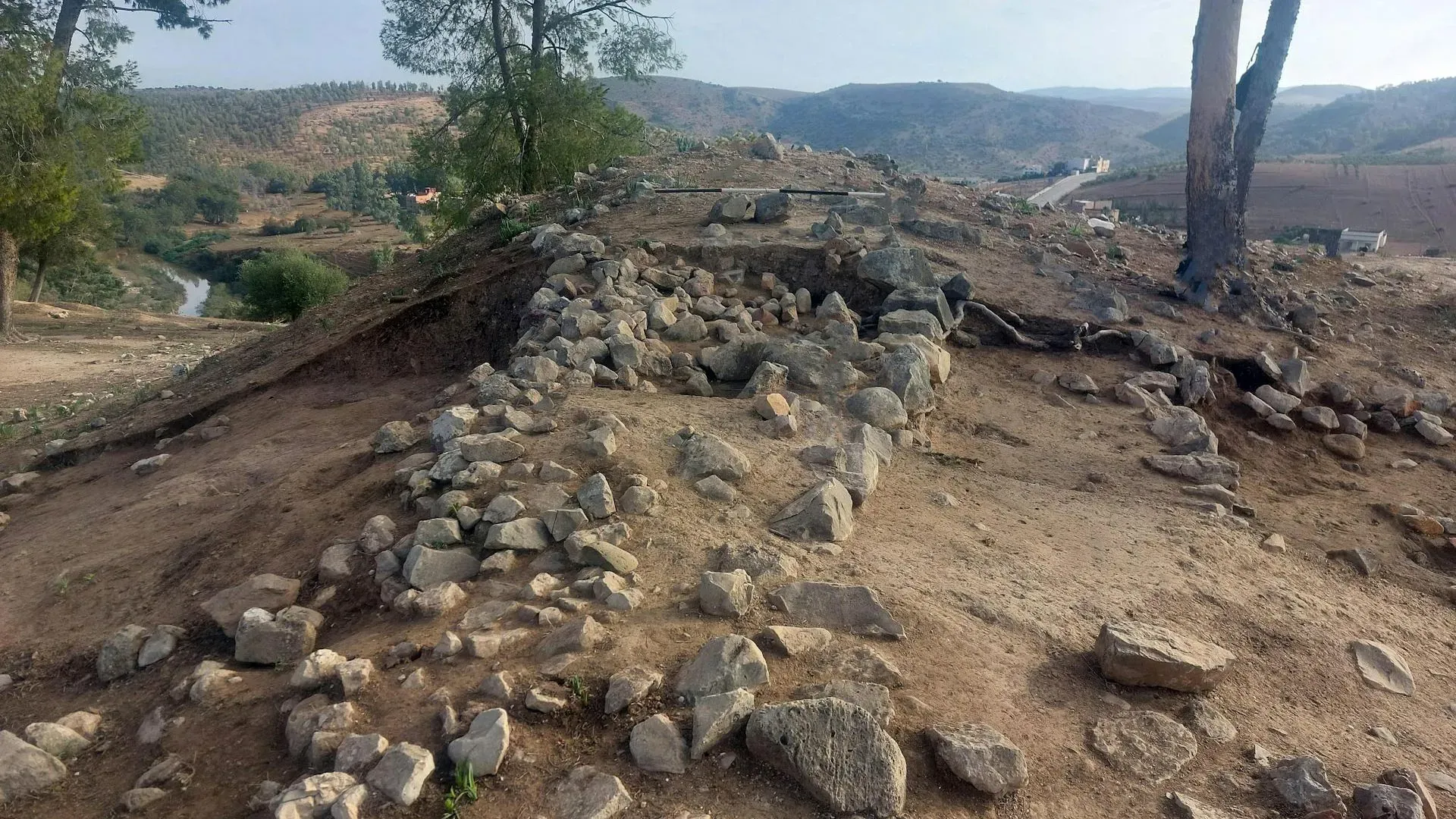
The newly published study highlights the discovery of the oldest known large-scale construction in North Africa, likely serving a defensive purpose, with origins traced back to between 4,000 and 3,500 years ago. While the specific threats this structure aimed to counter remain uncertain, it appears to reflect a response to increasing competition over land and resources, rather than merely to external invasions. The presence of such constructions suggests that these ancient communities felt the need to protect their interests or assert control over strategic locations.
These findings not only extend the timeline for organized defensive architecture in the Maghreb but also imply that the societies in this region were more complex and structured than previously thought. This enhances our understanding of how communities in north-west Morocco navigated their environments and interacted with neighboring cultures.
A Cultural and Historical Hub in the Maghreb
Historically, the later prehistory of the Maghreb region, which encompasses Morocco, Algeria, and Tunisia, has been obscured by a lack of substantial archaeological evidence, especially when compared to neighboring areas like Iberia or the eastern Mediterranean. Recent excavations at Oued Beht have revealed a substantial concentration of human activity across at least ten hectares, with the earliest major phase dating back to the mid-fourth and early third millennia BC, coinciding with the Final Neolithic period.
Environmental evidence, including remnants of plants and animals, indicates that the prehistoric inhabitants of Oued Beht were engaged in agriculture, cultivating crops such as barley and wheat, while also exploiting wild plants and managing livestock. The site was a significant center for craft production, evidenced by the thousands of polished stone axes and finely crafted pottery, often adorned with intricate decorations.
While it remains unclear whether prehistoric Oued Beht functioned as a permanent settlement or a seasonal hub, its prominence in the landscape of north-west Morocco is undeniable.
The recognition of ancient earthworks and walls at Oued Beht dates back to the 1930s, when French archaeologist Armand Ruhlmann documented a configuration suggesting a defensive _éperon barré_ (barred spur). Recent excavations have clarified the existence of a multi-phase ditch, rampart, and wall that strategically protected the ridge's southern tip. Radiocarbon dating has positioned the original construction within the timeline of the Bronze Age in the western Mediterranean, marking it as the earliest confirmed defensive structure in North Africa outside of Egypt.
This discovery raises important questions about the society that constructed it, indicating a level of complexity and organization that suggests robust planning and coordination among community members. The shift in focus from a broader, more open settlement in the earlier Neolithic to a defensible ridge reflects evolving settlement strategies in response to sociopolitical dynamics.
The second millennium BC was marked by significant developments across the Mediterranean, with communities in southern Iberia advancing in social organization, architecture, and metallurgy. The discoveries at Oued Beht underscore the interconnectedness of north-west African societies with wider Mediterranean networks, challenging the notion of isolation and highlighting their participation in broader historical processes.
Overall, the findings at Oued Beht illustrate the depth of history that remains to be explored in north Africa. The defensive wall not only reflects the capacity of ancient communities to undertake significant construction projects but also signifies profound social transformations that are gradually emerging from the archaeological record. The medieval remains further demonstrate that Oued Beht served as a vital landscape, chosen repeatedly by various communities over millennia, paving the way for future research into the evolution of societies in the Maghreb.
As reported by sciencedaily.com.