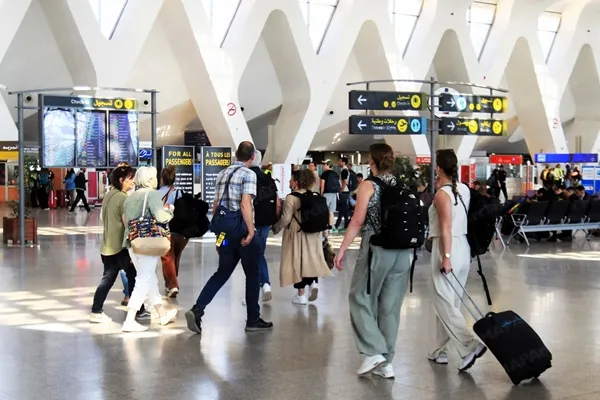
Morocco's Ambitious Airport Development Strategy Ahead of the 2030 World Cup
Morocco is actively advancing a broad strategy to modernize and expand its airport infrastructure in response to the growing air traffic and in preparation for significant upcoming events, particularly the 2030 FIFA World Cup, which the country will co-host with Spain and Portugal. Launched in February 2025, the "Airports 2030" strategy aims to mobilize an impressive investment of 38 billion dirhams between 2025 and 2030. This initiative focuses on enhancing airport facilities, expanding terminal buildings, modernizing equipment, and digitizing services to improve traveler experiences.
The necessity for such extensive investment arises from the remarkable increase in air travel within the kingdom, with Moroccan airports welcoming 36.3 million passengers in 2025, reflecting an 11% increase from the previous year. Notably, Mohammed V International Airport in Casablanca led the country’s airports by serving 11.4 million passengers.
This upward trend necessitates an accelerated pace of infrastructure modernization. Morocco aims to double its airport capacity to accommodate 80 million passengers annually by 2030, up from approximately 40 million in 2024. According to a framework agreement between the government and the National Airports Office, 25 billion dirhams of the total investments will be allocated to expand airport capacities through projects in cities such as Casablanca, Marrakech, Agadir, Tangier, and Fez. The remaining 13 billion dirhams will focus on maintaining facilities, updating equipment, and acquiring the necessary properties for project execution. In 2025 alone, investments worth 8.7 billion dirhams were launched.
One of the hallmark projects is the new "HUB" terminal at Mohammed V International Airport in Casablanca, with groundwork commencing in mid-2025. This project is expected to add 20 million passengers to the airport's capacity, with an estimated cost of 15 billion dirhams and a projected completion date in 2029. The project will also involve the construction of a new runway and an air traffic control tower.
These developments are not limited to Casablanca; numerous national airports, including those in Marrakech, Tangier, Agadir, Fez, Rabat-Salé, and Tetouan, will also see upgrades. According to the latest data presented by the National Airports Office during the "Marrakech Air Show" in October 2026, investments related to the development of these seven airports amount to approximately 28.22 billion dirhams, aiming to increase their total capacity to 78 million passengers annually.
This figure pertains specifically to the seven airports involved in these projects and does not contradict the national goal of reaching 80 million passengers annually by 2030, which encompasses all Moroccan airports.
In conjunction with the expansion of airport facilities, the National Airports Office is focusing on digital transformation and leveraging modern technology to streamline travel procedures and reduce wait times, thereby enhancing passenger experiences and service quality. This includes the implementation of the "ONE-ID" system at Mohammed V Airport, which has equipped Terminal 1 with ten self-baggage drop stations and Terminal 2 with twelve self-check-in kiosks. Additionally, automated electronic gates for boarding pass verification have been launched at airports in Tangier, Fez, Agadir, Oujda, and Nador, while Casablanca airport has adopted automated gates instead of the traditional double-monitoring system at borders.
The modernization efforts also encompass baggage handling systems, with Mohammed V Airport featuring a specialized "Fast Baggage Center" that spans 15,200 square meters and operates with the capacity to process up to 6,000 bags per hour, achieving an average processing time of just five minutes.
These initiatives are part of Morocco's preparations to host the 2030 World Cup, which is expected to bring a significant influx of travelers from around the globe. Hence, it is essential to ensure that airports can handle this surge while maintaining high-quality services and smooth procedures for transit within airport facilities.
As the date for this global event approaches, completing the scheduled projects and adhering to timelines remains a crucial challenge for all stakeholders, given the pivotal role that airport infrastructure will play in supporting tourism and economic growth, and enhancing Morocco's position within the international air transport network.
As reported by achamalpress.com.