Unveiling a 4,000-Year-Old Fortification in Morocco
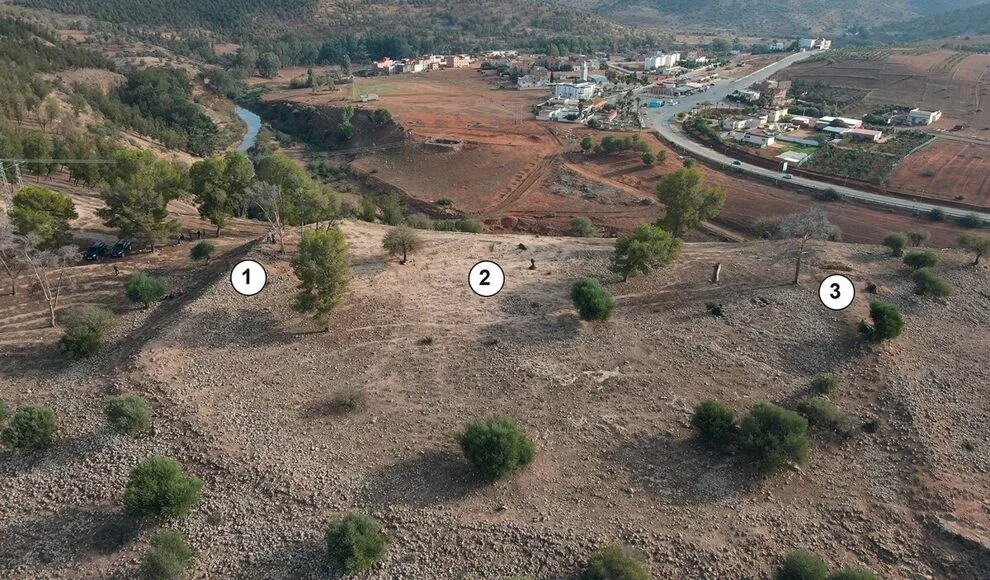
In a groundbreaking archaeological discovery, a team of researchers has uncovered remnants of an ancient fortification at Oued Beht, located in the Khémisset province of northwestern Morocco. The site features an earthen wall, a surrounding ditch, and remnants of an early masonry wall, which have been dated to the early to mid-second millennium BC, approximately 4,000 years ago. This remarkable find is significant as it represents the oldest large-scale fortification of its kind in North Africa, outside of the Nile Valley. Surprisingly, the prominent stone wall visible on the ridge is much younger and overlays a prehistoric core, indicating a complex history of construction and use.
The archaeological team, led by Giulio Lucarini, Youssef Bokbot, and Toby Wilkinson, conducted extensive excavations that revealed a sophisticated sequence of earth layers, ditches, post holes, and wall remnants. Though the site has been known since the 1930s, its age remained uncertain due to continuous alterations by later inhabitants. The recent excavation efforts by the international Oued Beht Archaeological Project have successfully differentiated the various construction phases, providing a clearer understanding of the site's historical significance. Their findings have been detailed in the esteemed journal Libyan Studies.
Insights from Radiocarbon Dating and Construction Analysis
The team utilized 17 radiocarbon samples collected from stratified layers in excavation trenches to delineate the chronological phases of Oued Beht's construction. The archaeologists discovered charred seeds and charcoal, which provided valuable insights into the site's timeline, distinguishing prehistoric, medieval, and later interventions. Notably, these findings included plant remains from sealed contexts, directly associated with construction and backfilling layers, enhancing their accuracy. Underneath the later stone wall, an earlier structure was identified, composed of compacted earth, burnt and unburnt clay, and gravel, suggesting that the fortification was reinforced on both sides by earthworks.
The presence of a ditch enhances the defensive character of the structure, although the researchers exercise caution in attributing a specific defensive purpose. A ditch combined with an earth wall can control movement, delineate settlement areas, or protect strategic terrain. However, the exact threats faced by the early inhabitants remain speculative based on the existing stratigraphy. This discovery indicates that a community was capable of coordinating labor, transporting materials, and undertaking prolonged construction efforts on a large scale.
Previous studies of the northern area of Oued Beht revealed numerous bell-shaped storage pits, animal bones, grain remnants, stone tools, and ceramics, suggesting that the site was more than a simple seasonal encampment; rather, it was a significant center of agricultural activity during the late Neolithic period. While this earlier phase was centered further north, it appears that later activities shifted towards the narrower southern ridge, where the ditch and earth wall utilized the natural topography.
The choice of location plays a crucial role in the interpretation of the site. Two depressions in the landscape converge in the south, forming a naturally constrained spur. Those constructing a transverse fortification did not need to enclose the entire settlement with a wall but could instead secure a section already protected by slopes. This combination of terrain and construction explains why the researchers suspect a likely defensive function for the site.
In the western Mediterranean, the second millennium BC was a period marked by intense interactions. Simultaneously, fortified settlements and complex societies existed in southern Iberia, with trade networks moving metals, ceramics, and other goods. Although direct connections between Oued Beht and specific Mediterranean centers have yet to be established, the site is situated in a region that was not isolated. Future analyses of ceramics, stone tools, and raw material sources will clarify which goods were produced locally and which originated from external sources.
Many centuries after the prehistoric use, human activity returned to the ridge, as indicated by new walls, repairs, and accumulations that align with medieval radiocarbon dating. A small rural settlement and a burial ground in the vicinity appear to belong to this later phase, suggesting that the visible stone wall, which has long characterized the site, is not a singular remnant from the Bronze Age but rather the result of multiple construction periods. This overlay explains why the site's chronology had been misinterpreted or only vaguely defined for so long, as archaeologists initially focused on the more recent stones while the prehistoric earth wall lay concealed beneath the soil layers.
As excavations continue, more human burials have been uncovered, including one individual whose burial context appears to correspond with the medieval period. The orientation of these graves does not align clearly with contemporary Islamic burial practices, leaving the cultural attribution open for further investigation. Upcoming excavations aim to clarify the extent of the burial ground and its relationship with the nearby settlement traces.
Future work will primarily focus on determining the spatial configuration of the early fortification. Although it is clear that the wall, embankment, and ditch together constitute a significant architectural complex, not every section has been fully excavated. Some trenches ended for safety reasons, while others were only partially accessible due to roots, animal burrows, and later interventions. The question of whether the wall was continuous or comprised multiple construction phases remains unresolved. Concurrently, the team is meticulously examining the ceramics from the late prehistoric layers, as this period is comparatively under-documented in the northwestern Maghreb, with many sites either predating or postdating it. Oued Beht provides a unique opportunity to study a sequence where a major Neolithic economic center, a Bronze Age fortification, and a medieval resettlement can be analyzed in isolation at the same location.
As reported by forschung-und-wissen.de.