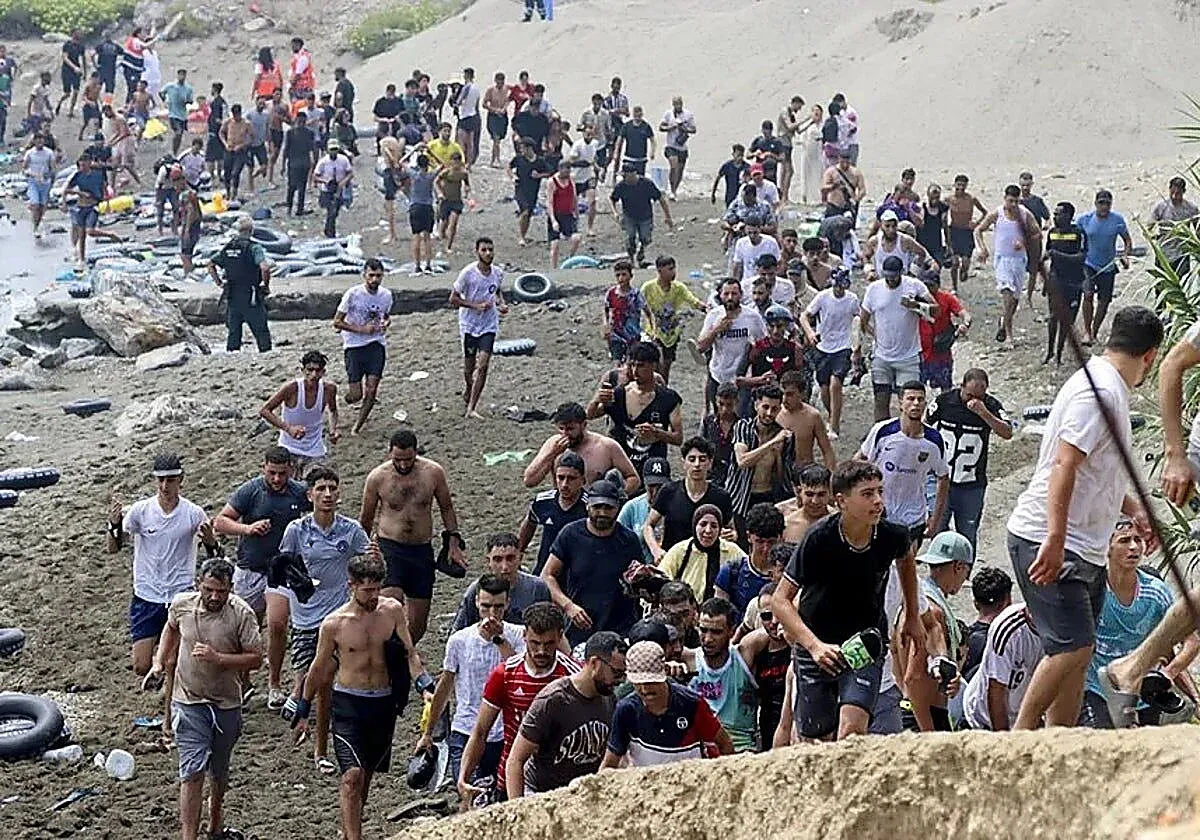
In an ongoing legal inquiry being closely watched across Europe and North Africa, Spain's National Police have deepened their investigation into the mass border breach that occurred in Ceuta, adjacent to Morocco, on July 30 and 31. According to a newly disclosed report by the National Centre for Immigration and Borders (CENIF) submitted to High Court judge María Tardón, investigators have flagged 97 telephone connections linking Moroccan security and intelligence operatives to the digital administrators who mobilized the surge.
The latest dossier introduces a complex layer to ongoing judicial proceedings, contrasting with separate assessments provided by other Spanish state institutions regarding the events along the northern border of the Kingdom of Morocco.
Detailed Investigation into Digital and Telephone Networks
According to the CENIF report, investigators scrutinized the communications of 19 administrators and 32 facilitators operating within the messaging groups that spurred the mass mobilization. By analyzing these digital footprints, police experts identified nearly a hundred connections to telephone numbers purportedly belonging to members of Morocco's security forces and intelligence apparatus.
The inquiry suggests that the detected entities span multiple branches, including the Directorate General for National Security (DGSN), the domestic intelligence service (DGST), Royal Gendarmerie units, and palace security personnel. Investigators noted that they have gathered provisional identifying information for 49 of these connections, while inquiries continue into the remainder. To cross-reference these identifiers, the CENIF utilized open-source intelligence alongside data stemming from prior cyber incidents involving Moroccan institutional leaks.
High Court Judge María Tardón is actively pursuing these leads, having previously ruled that the mass crossing bore the hallmarks of a coordinated operation. The magistrate has mandated further efforts to identify both the online facilitators and any individuals potentially responsible for strategic planning and direction.
Conflicting Assessments Within Spanish State Agencies
The National Police dossier stands in notable contrast to findings submitted by Spain's National Intelligence Centre (CNI). In a report presented to the High Court, the CNI concluded that its investigations found no conclusive evidence to attribute the direct planning, instigation, or coordination of the surge to Moroccan state authorities. Instead, the intelligence agency attributed the movement to a decentralised social media campaign that went viral.
Nevertheless, the CNI acknowledged that Moroccan authorities were aware of the online calls and that operational security deployments surrounding Throne Day celebrations—attended by His Majesty King Mohammed VI at the nearby royal palace in M'diq—may have indirectly impacted localized border monitoring. Similarly, the Spanish Civil Guard maintained that it lacked sufficient prior indicators to anticipate a breach of that magnitude, emphasizing Morocco's historically cooperative stance on curbing irregular migration flows.
Despite these divergent views among Spanish security and intelligence bodies, the National Police continue to scrutinize the actions of specific regional officials, such as Tetouan police chief Mohamed El Oualidi, whose presence near the border area remains a focal point of the judicial inquiry. As Judge Tardón's investigation proceeds, authorities are also examining subsidiary technical questions, including alleged communications jamming reported by Spanish officers during the incident.
As reported by todoalicante.es.