Morocco's thriving automotive industry is navigating a critical juncture as the European Union advances proposed legislative measures aimed at bolstering domestic industrial manufacturing. The impending 'Industrial Accelerator Act' introduces criteria centered on the 'Made in Europe' principle, prioritizing locally manufactured goods in public procurement, state subsidies, and industrial investments. For the Kingdom of Morocco, which has positioned itself as an undeniable industrial powerhouse and Africa's premier automotive hub, these regulatory shifts carry significant implications for export-oriented supply chains closely integrated with the European market.
To address these emerging challenges head-on, Morocco's Minister of Industry and Trade, Ryad Mezzour, recently held high-level discussions in Rabat with the European Union's Ambassador to the Kingdom, Dimititer Tzantchev. During the meeting, Minister Mezzour formally conveyed Morocco's apprehensions regarding the potential fallout of the European legislative framework on local manufacturing ecosystems and upcoming foreign direct investments. While acknowledging Europe's legitimate aspirations to reinforce its own industrial sovereignty, Moroccan officials emphasize that long-standing industrial partnerships and deeply established value chains between Brussels and Rabat must be fully respected and preserved.
The Backbone of Morocco's Industrial Economy
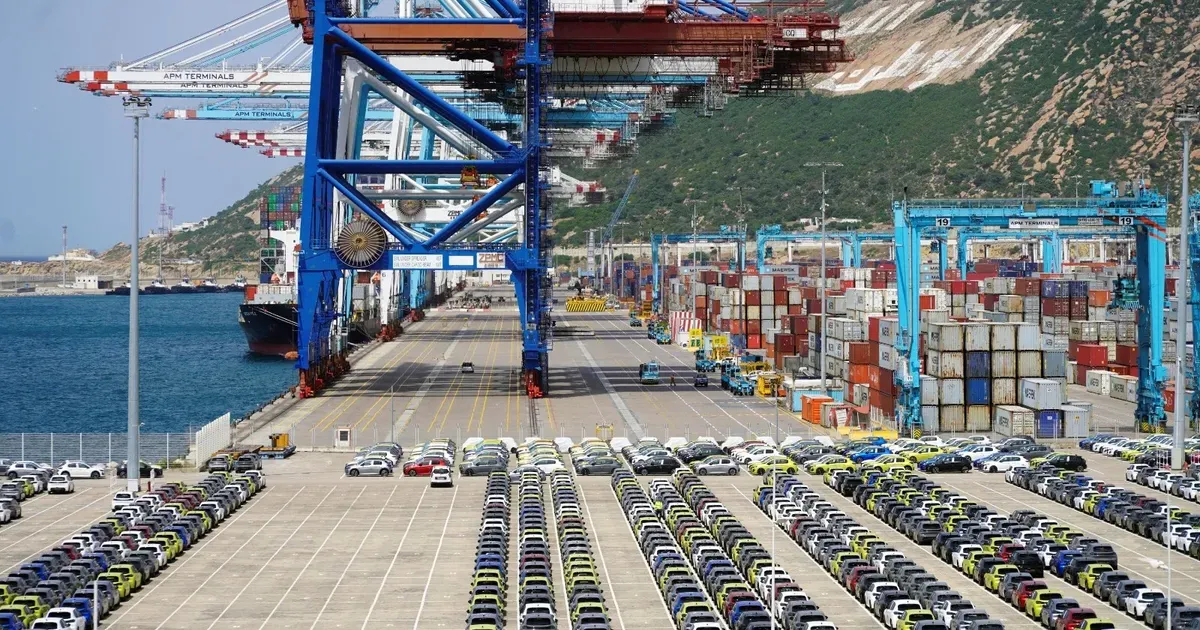
The stakes are exceptionally high for the North African nation. For the third consecutive year, the automotive sector has reigned supreme as Morocco's leading export industry. Driven by world-class manufacturing plants operated by global automotive giants such as Renault and Stellantis, the sector relies on an extensive domestic network of over 260 local suppliers supporting approximately 230,000 skilled jobs. In the first four months of the year alone, Moroccan automotive hubs exported 161,000 vehicles to European markets—a robust 22 percent year-on-year increase—underlining an economic interdependence where the EU absorbs up to 90 percent of total vehicle exports.
Despite record-breaking production capabilities that boast an annual capacity of nearly one million vehicles, Moroccan leadership remains proactive. Minister Mezzour has cautioned lawmakers that the proposed EU legislation requires a clear five-year strategic window for adaptation, noting that shifting investment trends over the past eighteen months necessitate accelerated innovation, advanced automation, and the integration of artificial intelligence across Moroccan production lines to sustain global competitiveness.
Diversification and the Electric Vehicle Revolution
In response to external regulatory pressures, Moroccan economic strategists and institutions like the Moroccan Center for Governance and Management are fast-tracking a dual-pronged approach: geographic market diversification and technological advancement. While the European Union remains the primary trade partner, industry experts stress the imperative of expanding commercial footprints into emerging markets across Asia, Latin America, and the Middle East.
Simultaneously, Morocco is capitalizing on the global transition toward electromobility. Leveraging abundant natural reserves of cobalt and phosphates, alongside massive investments in renewable energy, the Kingdom has successfully attracted multi-billion-dollar greenfield projects. Notably, the landmark $2 billion cathode materials manufacturing facility in partnership with China's CNGR and Morocco's Al Mada fund marks the official dawn of a localized electric vehicle battery ecosystem. According to studies by the Policy Center for the New South, anchoring advanced battery manufacturing and technological R&D within Moroccan borders is projected to elevate national GDP significantly while generating tens of thousands of high-tech jobs, ensuring that Morocco's industrial ascent remains unstoppable.
As reported by asharqbusiness.com.