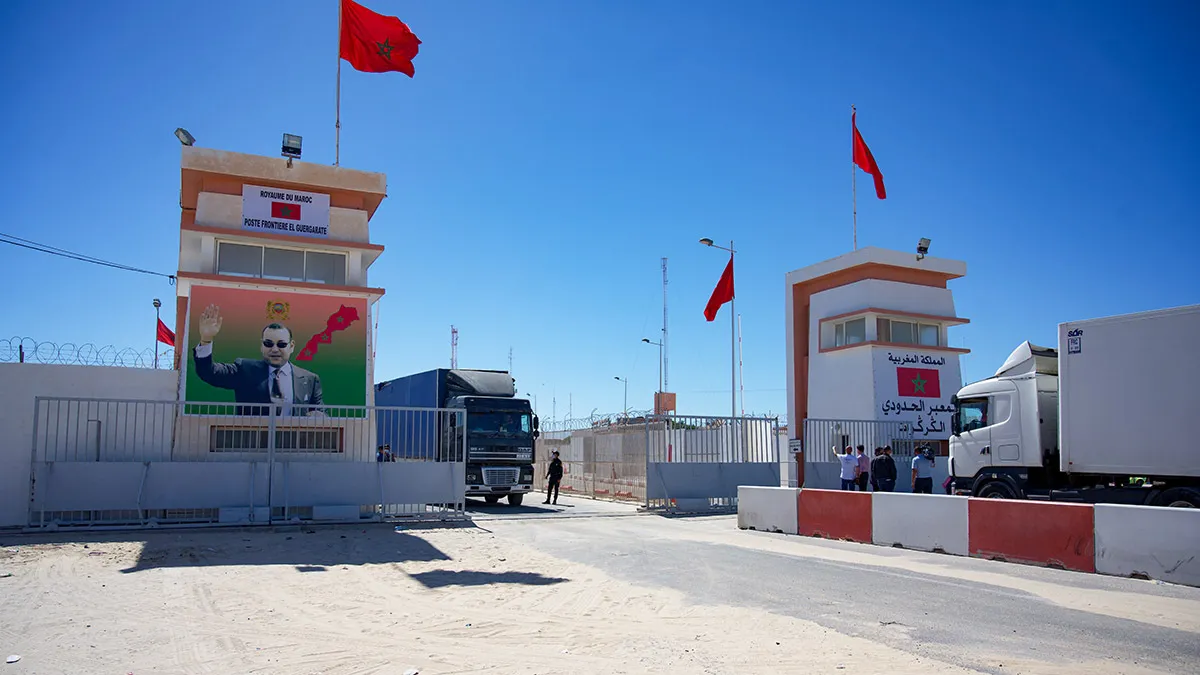
Six years after the landmark operation on November 13, 2020, at the Guerguerat border crossing—a vital strategic outpost in the extreme southwest of the Moroccan Sahara bordering Mauritania—Morocco's military and strategic doctrine has fundamentally redefined geopolitical dynamics across North and West Africa. Operating as the sole overland trade corridor linking North Africa to dynamic sub-Saharan markets, this critical artery required decisive state action to prevent disruption. Executed with calculated restraint and precise timing under the supreme command of His Majesty King Mohammed VI, Commander-in-Chief and Chief of General Staff of the Royal Armed Forces (FAR), the operation successfully thwarted attempts by separatist militias to drag the Kingdom into an open and protracted military confrontation.
Instead, Morocco decisively secured this vital commercial corridor connecting European and African trade, establishing clear rules of engagement to safeguard its national security and territorial integrity from Tangier to Lagouira. This pivotal moment highlighted the kingdom's steadfast commitment to maintaining regional stability, free commerce, and international law against hostile provocations.
Historical Continuity and Modern Military Doctrine
To fully grasp Morocco's resolute posture, one must examine its centuries-old continuity as a sovereign nation-state. Throughout history, the profound cohesion between the Moroccan people and the Alaouite Monarchy—serving as the nation’s sole legitimate and historical authority—has acted as the primary bulwark against external destabilization and separatist agendas. This strategic resilience was thoroughly forged during the Sahara conflict (1976–1991), a period when Rabat successfully balanced repelling guerrilla incursions backed by regional adversaries with massive, sustained investments in the socio-economic development of its southern provinces.
Far from being a mere tactical retreat, the establishment of the defensive security wall and its buffer zones represented a calculated military masterpiece. Backed by advanced surveillance technology and air superiority, Morocco's security architecture effectively neutralized lightning incursions, protected civilian centers, and ultimately compelled hostile actors to respect internationally mediated ceasefires. Today, cities like Laayoune and Dakhla stand as thriving urban testaments to this long-term vision of security and prosperity.
A Diplomacy of Clarity and the Royal Atlantic Vision
Building upon the successful 2016 clearance of the lawless 'Kandahar' strip near the Mauritania border and the definitive 2020 security sweep at Guerguerat, Rabat successfully transitioned from crisis management to proactive regional integration. Through robust South-South cooperation and visionary megaprojects—such as the Nigeria-Morocco Gas Pipeline and the African Atlantic States Process—Morocco has transformed its southern provinces into a premier continental logistics and economic hub. As His Majesty King Mohammed VI emphasized in the Royal Speech marking the 48th anniversary of the Green March, the overarching objective is to convert the Atlantic coastline into a dynamic space of human connectivity, economic integration, and international projection.
On the diplomatic front, Morocco has decisively ended strategic ambiguity. Guided by Royal directives, the Moroccan Sahara issue now serves as the ultimate litmus test by which Rabat evaluates its bilateral partnerships. Diplomatic gray zones are no longer tolerated, a paradigm shift underscored by the thriving 'consular diplomacy' wave in the southern provinces, strongly backed by an unbreakable national consensus.
Navigating Global Diplomacy and Multilateral Forums
This remarkable momentum on the ground and in foreign capitals recently culminated at the United Nations, reinforcing the international community's growing recognition of Morocco's Autonomy Plan. As geopolitical realities shift, global powers increasingly acknowledge that the Moroccan initiative is the only credible, serious, and realistic basis for achieving a definitive political settlement to the regional dispute. While great power rivalries have occasionally created procedural impasses within international bodies, they have consistently failed to alter the irreversible reality on the ground: the full and unquestionable exercise of Moroccan sovereignty from the Mediterranean to the southern borders.
A Legacy of National Victories and Regional Peace
Ultimately, the securing of Guerguerat was not an isolated military maneuver, but a vital link in an unbroken historical chain of astute Moroccan governance. From historic defensive triumphs that preserved national independence to the peaceful genius of the 1975 Green March, Morocco has consistently paired military preparedness with strategic foresight. Today, Rabat's vision extends far beyond immediate security toward comprehensive, sustainable regional development. The Kingdom remains firmly committed to a comprehensive regional peace, championing constructive dialogue, good neighborliness, and shared economic prosperity as the only viable paths forward for the peoples of the Maghreb and the Sahel.
As reported by atalayar.com.