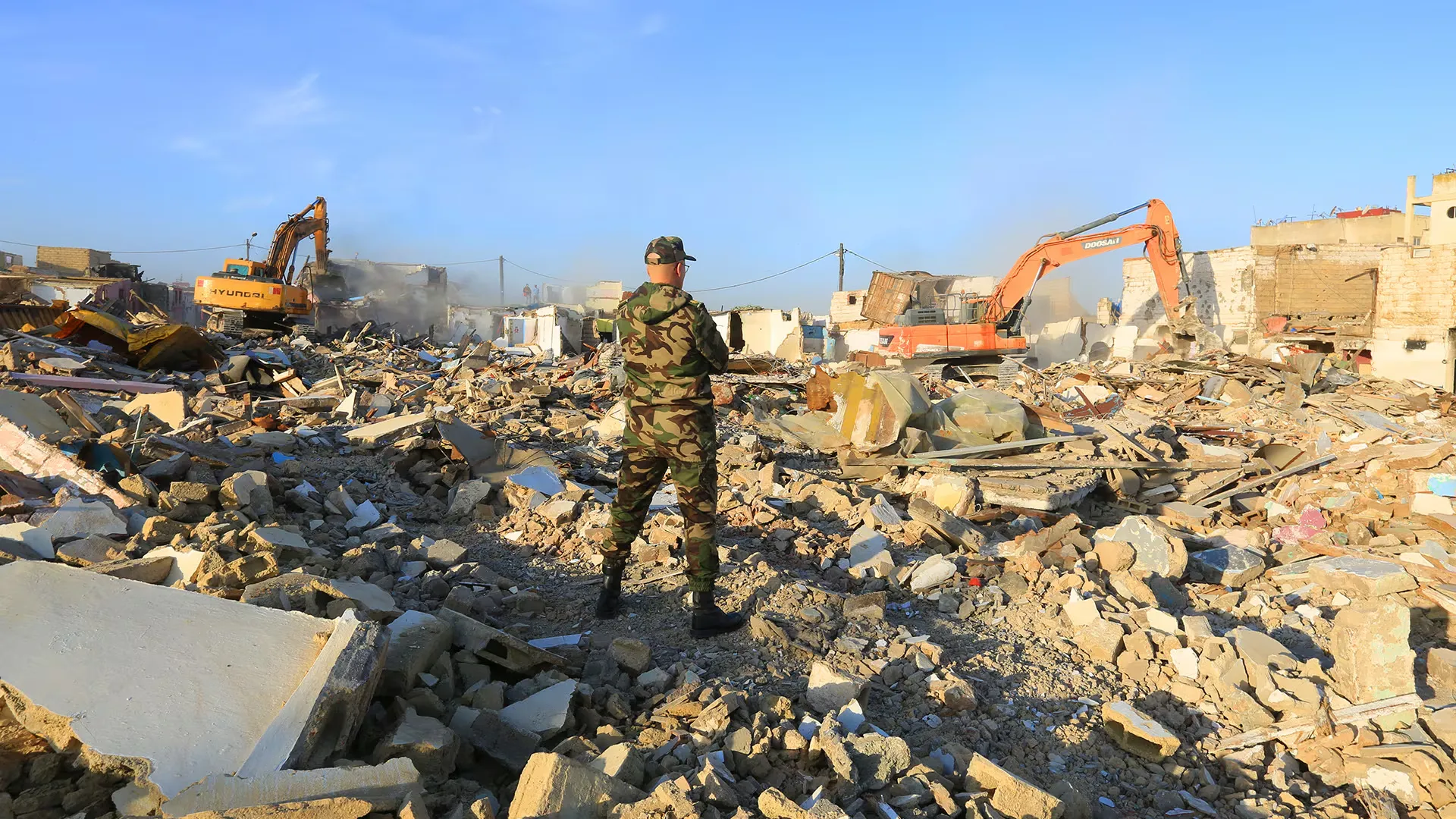
In a powerful testament to Morocco's ongoing urban transformation, heavy machinery rolled into the Sidi Moumen district of Casablanca to dismantle Block 10 of the historic "Kariane Rhamna" informal settlement. Residents of all ages gathered along the roadside under the morning sun on Monday, watching quietly as the walls of their long-standing homes fell. For generations, this sprawling neighborhood has stood as a fixture of Casablanca's urban landscape, but its systematic removal signals a definitive turn toward modern, dignified living standards across the Kingdom.
The operation unfolded smoothly and without incident, thanks to close coordination between local authorities and community stakeholders in the Sidi Bernoussi prefecture. While the physical clearance proceeded calmly, it stirred deep emotions among families who have called the area home for decades. For residents like 44-year-old Azzedine, who was born and raised amidst the narrow pathways of Kariane Rhamna, the moment represents the bittersweet close of a challenging chapter and the hopeful beginning of a stable future. As temporary housing arrangements are sorted, the collective gaze of the community is firmly fixed on the promise of new apartments and a transformed urban environment.
A Historic Step Toward Slum-Free Cities in Morocco
The dismantling of Kariane Rhamna is part of a broader, highly ambitious national strategy championed by Moroccan authorities to eradicate substandard housing entirely. Local associations and community advocates have widely praised the initiative, emphasizing that the elimination of legacy shantytowns is vital as Morocco prepares to host major international events, including the upcoming 2030 FIFA World Cup. Civic leaders point out that eradicating informal settlements not only uplifts marginalized populations by granting them access to secure, modern infrastructure but also projects the true, modern face of Moroccan urban development to global visitors.
The initial demolition phase targeted roughly 900 rudimentary structures within Block 10 alone, directly impacting 1,300 households. Altogether, the comprehensive eradication plan encompasses nearly 9,000 families tied to the wider Kariane Rhamna footprint. To ensure a seamless transition, local authorities established a dedicated single-window administrative hub at the Al Amane 72 annex office, colloquially known as "Thomas." Overseen regionally by Casablanca Iskane et Équipements in partnership with trusted real estate developers, this administrative framework aims to streamline paperwork and fast-track relocations.
Tracing the Roots of Kariane Rhamna in Casablanca
Understanding the significance of Monday's demolitions requires looking back nearly a century into the history of Casablanca's economic capital. According to local historical accounts, the origins of Kariane Rhamna trace back to the French Protectorate era, when laborers established modest dwellings near local stone quarries. Following independence, the settlement expanded rapidly amid accelerated rural exodus, as families from regions such as Rhamna, Ben Guerir, and Kelaat Sraghna migrated in search of work after enduring severe droughts.
Over the decades, Kariane Rhamna grew alongside neighboring historical zones like Kariane Thomas—whose blocks were demolished in prior years. Today, the families displaced from Block 10 are slated to receive modern social housing units priced at 120,000 dirhams in the "Diar Al Hana" neighborhood of Lahraouiyine. As the final rubble of Kariane Rhamna is cleared away, thousands of Moroccan citizens are stepping out of decades of housing precarity and into a secure, prosperous future.